2026 WINNER · CYBERSECURITY STARS AWARDS

DeepKeep · AI Security Platform

Best Artificial Intelligence Security Platform

2026 Winner medal
DeepKeep logo
Company
DeepKeep
Location
Israel
Website
Team Size
50 - 99 employees
01

Overview

DeepKeep provides end-to-end AI security and trustworthiness across the full AI lifecycle. Its platform protects multimodal systems – including large language models and computer vision, AI agents, and the applications, automations, and workflows built around them – helping enterprises deploy and use AI safely, accurately, and in compliance with security and privacy standards. With capabilities such as an AI Firewall, AI Red Teaming, AI Usage Control and advanced Model Scanning, DeepKeep enables cybersecurity teams to defend against vulnerabilities, data leakage, hallucinations, and bias while maintaining trust in AI-driven operations. Founded in 2021 by Rony Ohayon and a team of AI and cybersecurity experts, DeepKeep is dedicated to securing the future of enterprise AI.

02

Key Capabilities

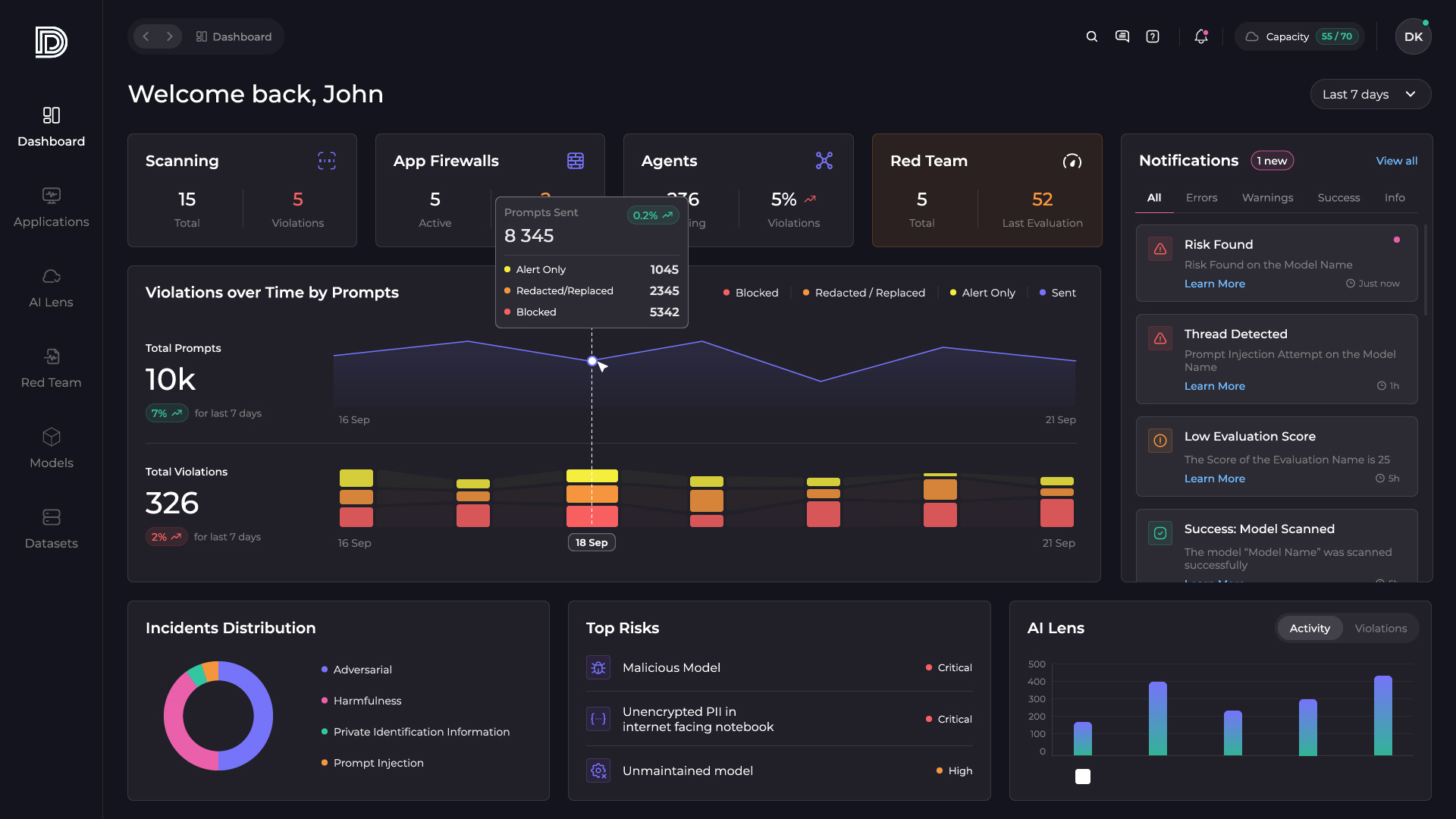
DeepKeep's platform secures enterprise AI across its full lifecycle, from pre-deployment testing through continuous runtime protection, covering AI applications, autonomous agents, and employee AI usage within a single integrated system.

  • AI Red Teaming: DeepKeep's AI Red Teaming platform tests foundation models, applications, and autonomous agents across single-turn, multi-turn, and multi-session interactions, covering both security threats and trust risks - prompt injection, jailbreaking, data leakage, bias exploitation, agent misuse, hallucinations, toxicity, and more across dozens of topics. Automated Red Teaming runs continuously across development and staging environments, generating adversarial prompts dynamically based on topic and context rather than static playbooks, with CI/CD integration and event-driven re-scans triggered when models or dependencies change. Every finding includes full traces, adversarial prompts, responses, and decision logic, supported by root-cause analysis that identifies underlying weaknesses rather than surface symptoms. Vibe AI Red Teaming is a human-steered mode powered by Reddy, DeepKeep's AI red teaming agent, that changes how AI red teaming is practiced. Security teams define objectives in plain language and Reddy executes, adapts, and escalates findings in real time as the target system responds. At key decision points, execution pauses for the team to review, redirect, or push deeper. Manual red teaming cannot scale; fully automated testing follows scripts; attackers do not. Vibe eliminates that tradeoff. Both modes cover multimodal AI systems, testing image inputs for visual injection attacks and trust risks such as mislabeling alongside text-based threats, and produce risk-aware reports aligned with CISO decision-making. The platform maps to OWASP, NIST, and GDPR.
  • AI Firewall: DeepKeep's AI Firewall evaluates every prompt and response in real time across AI applications, autonomous agent workflows, and employee AI interactions. At its core is a multi-tier detection architecture combining cognition-based analysis and language classifiers - cognition-based analysis operates with low latency, covers zero-day attacks, and works natively across languages without translation, in direct contrast to LLM-as-a-judge approaches which are slower, prone to manipulation, and introduce the same bias risks they are meant to detect. The firewall provides over 60 contextual guardrails for both security and trust, covering prompt injection, jailbreaks, adversarial attacks, harmful outputs, bias, toxic content, hallucination risks, and unauthorized data exfiltration. Personal data protection is among the most requested guardrails: the PII guardrail detects and redacts sensitive personal data in real time using contextual understanding, outperforming Microsoft Presidio across a broader range of data categories with fewer false alerts, and supporting GDPR, CCPA, LGPD, and PIPA compliance. Guardrails operate contextually across conversational history, industry-specific language, and regional regulatory requirements. Protection extends beyond text to multimodal AI systems. The firewall can be deployed inline or out-of-band, supports SaaS, private cloud, on-premise, and air-gapped environments, and integrates into existing stacks without architectural changes. Critically, vulnerabilities identified during red teaming can be translated directly into guardrails deployed in the firewall, closing the loop between simulation and production enforcement.
  • AI Agent Scanner: As AI agents operate with growing autonomy across enterprise data, tools, and workflows - and increasingly interact with each other across complex pipelines - the attack surface expands in ways that are difficult to visualize or control. DeepKeep's AI Agent Scanner maps this surface end to end, inspecting every LLM, tool, integration, and component involved in agent execution. It generates a visual attack surface map showing how prompts flow, where tools are invoked, and where exploitation paths exist, making complex agent architectures concrete and actionable for security and engineering teams. It identifies vulnerabilities across agent structure including weaknesses in user input handling, tool invocations, and indirect prompt injection, and delivers a prioritized remediation playbook with step-by-step guidance. It also addresses the growing low- and no-code agent layer - platforms like n8n, CrewAI, Make, and Dify where agents are composed without traditional engineering workflows - giving security teams visibility into a layer that is otherwise a blind spot.
  • Model Scanning: DeepKeep's Model Scanning provides automated pre-deployment assessment of AI models, scanning both structure and behavior to identify vulnerabilities including bias, hallucinations, unsafe outputs, adversarial susceptibility, and data leakage risks. By analyzing model behavior under real-world conditions rather than inspecting code in isolation, it surfaces risks that only emerge when a model interacts with live data and users.
  • AI Lens: Employees connecting sensitive business data to unvetted AI tools outside security team visibility represents one of the most underestimated attack surfaces in the enterprise. DeepKeep's AI Usage Control capability delivers visibility and governance over how AI tools are accessed and used across the organization, enforcing consistent policies and ensuring only approved AI services are used across workflows.

Together these capabilities form an integrated security layer with shared context across development and production, connecting pre-deployment findings to runtime enforcement and giving security teams a unified view across the model, the applications built on it, the agents operating around it, and the employees interacting with it.

03

How we are different

DeepKeep covers the full AI security lifecycle in a single platform - pre-deployment testing, agent attack surface mapping, and continuous runtime protection - with shared context across every layer. This integration is where the real advantage lies: vulnerabilities discovered during red teaming feed directly into guardrails enforced by the AI Firewall at runtime, and risks mapped by the Agent Scanner inform where protections need to be placed. Testing and enforcement are connected, not siloed. This is only possible within a unified platform, and it is what separates DeepKeep from point solutions that address one layer of the stack in isolation.

The platform covers every actor in the enterprise AI ecosystem - AI applications, autonomous agents, and employees - across every deployment model. SaaS, private cloud, on-premise, and air-gapped environments are all supported, with inline and out-of-band configurations and no architectural changes required. Enterprises can adopt DeepKeep without compromising their infrastructure or compliance requirements.

Context-awareness runs through every layer of the platform. Guardrails evaluate prompts and responses across conversational history, industry-specific language, and regional regulatory requirements - distinguishing between unsafe content and legitimate business interactions rather than applying blanket filters. Red teaming generates adversarial scenarios based on topic and context, not static playbooks. Agent scanning maps exploitation paths across the full pipeline, not just individual components in isolation.

Protection extends beyond text. DeepKeep covers multimodal AI systems across both testing and runtime defense - visual injection attacks, mislabeling risks, and image-based threats alongside the full range of text-based vulnerabilities. As enterprises deploy computer vision and multimodal models into production, this coverage is no longer optional.

Native multilingual detection means the platform evaluates inputs and outputs in their original language without routing through translation, preserving the contextual meaning that translation loses. In benchmarks across multiple languages, native detection significantly outperformed translation-based approaches - accuracy on Japanese inputs improved from 0.614 to 0.834, German from 0.733 to 0.827. For global enterprise operations, this is a direct accuracy advantage, not a convenience feature.

Vibe AI Red Teaming changes how AI red teaming is practiced: Reddy executes and adapts while the security team steers through natural language, delivering adaptive depth-first testing at the speed of automation. The AI Agent Scanner is the first solution to visually map the full agent pipeline, identifying exploitation paths and delivering prioritized remediation across the emerging low- and no-code agent layer. DeepKeep's detection capabilities are grounded in original security research published at leading AI and security venues.

The platform is deployed across enterprise environments in North America, Europe, and APAC, with dozens of active enterprise evaluations underway.
04

Gallery