2026 WINNER · CYBERSECURITY STARS AWARDS
Elisity · Identity-Based Microsegmentation Platform
Best OT Security Platform



Elisity is an identity-based microsegmentation company that helps enterprises stop lateral movement, prevent ransomware spread, and meet compliance and cyber insurance requirements across IT, OT, and IoT environments. The Elisity platform discovers every device on an organization's network, enforces least-privilege access policies through existing network infrastructure, and delivers full microsegmentation in weeks - without agents, additional hardware, or network re-architecture.
Elisity is trusted by Fortune 500 healthcare systems, global manufacturers, and pharmaceutical companies including GSK, Main Line Health, Shaw Industries, and St. Luke's University Health Network. Founded in 2019, Elisity is headquartered in San Jose, California.
Industrial environments - factories, pharmaceutical plants, water and energy infrastructure, building systems - have become some of the highest-value targets for cybercriminals and nation-state actors. The reason is straightforward: a single compromise inside an operational technology (OT) environment can halt production, threaten worker safety, or trigger an environmental incident, and ransomware operators know it.
Yet most enterprises have struggled to extend modern security controls into OT because the equipment on the plant floor - programmable logic controllers (PLCs), human-machine interfaces (HMIs), robotic arms, building automation, and industrial sensors - physically cannot run security software, sits on flat networks, and cannot be taken offline for upgrades.
The Elisity Microsegmentation Platform was purpose-built to solve OT segmentation without disrupting production. It delivers identity-based microsegmentation on the network infrastructure manufacturers and critical-infrastructure operators already own, with no agents on devices, no rip-and-replace, and no production downtime. The platform implements the Zones and Conduits architecture defined in IEC 62443 - the international cybersecurity standard for industrial automation and control systems - in software. Security teams group OT assets into zones by function and security level, and the platform enforces controlled communications between zones (conduits) on the network equipment already running the plant.
The platform is organized around three capability themes.
Most plants and critical-infrastructure sites have 30 to 50 percent more connected devices than their inventory shows. The undocumented assets include legacy PLCs left in place after equipment changes, contractor-installed sensors, building controls, video surveillance, and shadow IoT. Attackers love these devices because they cannot run security agents and they often communicate freely across the plant network.
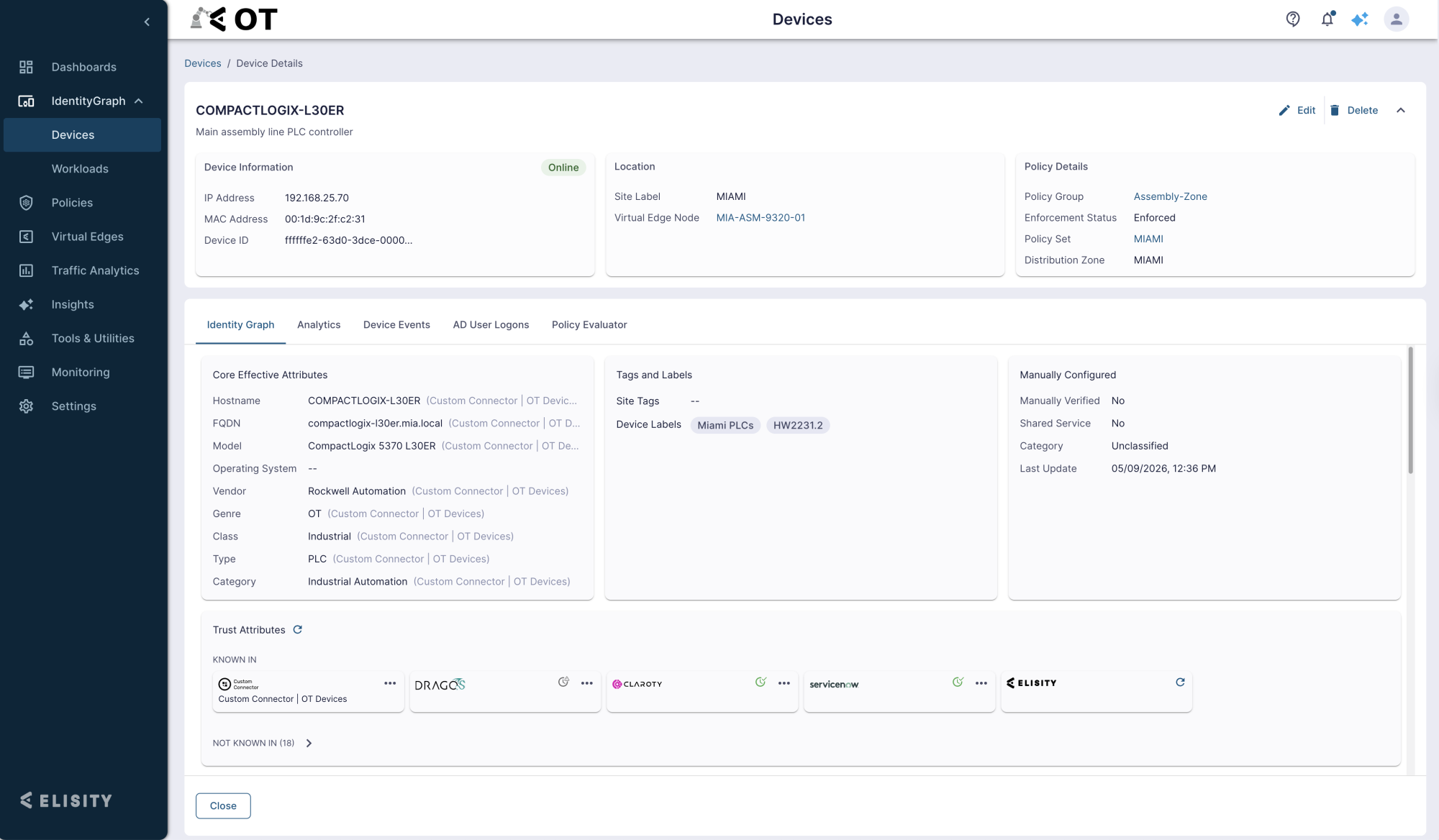
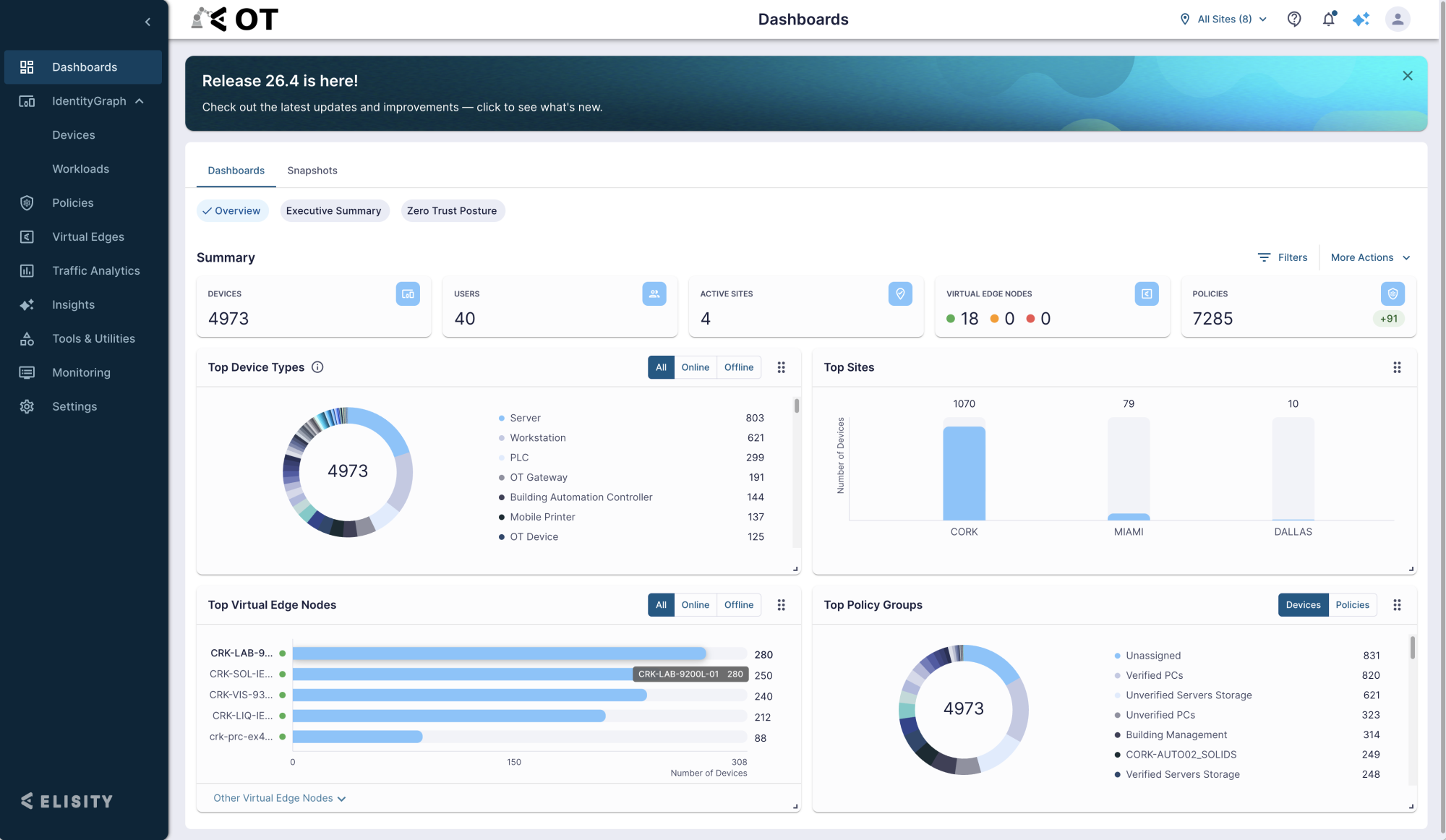
The Elisity IdentityGraph™ uses existing network equipment as a passive sensor and builds one real-time record per device. Every PLC, HMI, robot, sensor, HVAC controller, and engineering workstation is classified with business meaning - what production process it supports, what zone it belongs to, what its safety impact is, and what risk it carries - and assigned a single risk score.
IEC 62443 calls for an industrial environment to be divided into Zones (groups of assets with common security requirements) and Conduits (the controlled communication paths between zones). The standard is well understood by industrial security teams. The reason most manufacturers have not implemented it fully is the cost and disruption of the network re-architecture it has historically required: new firewalls between every zone, new VLAN designs, IP address changes, integration consultants, and multi-year programs.
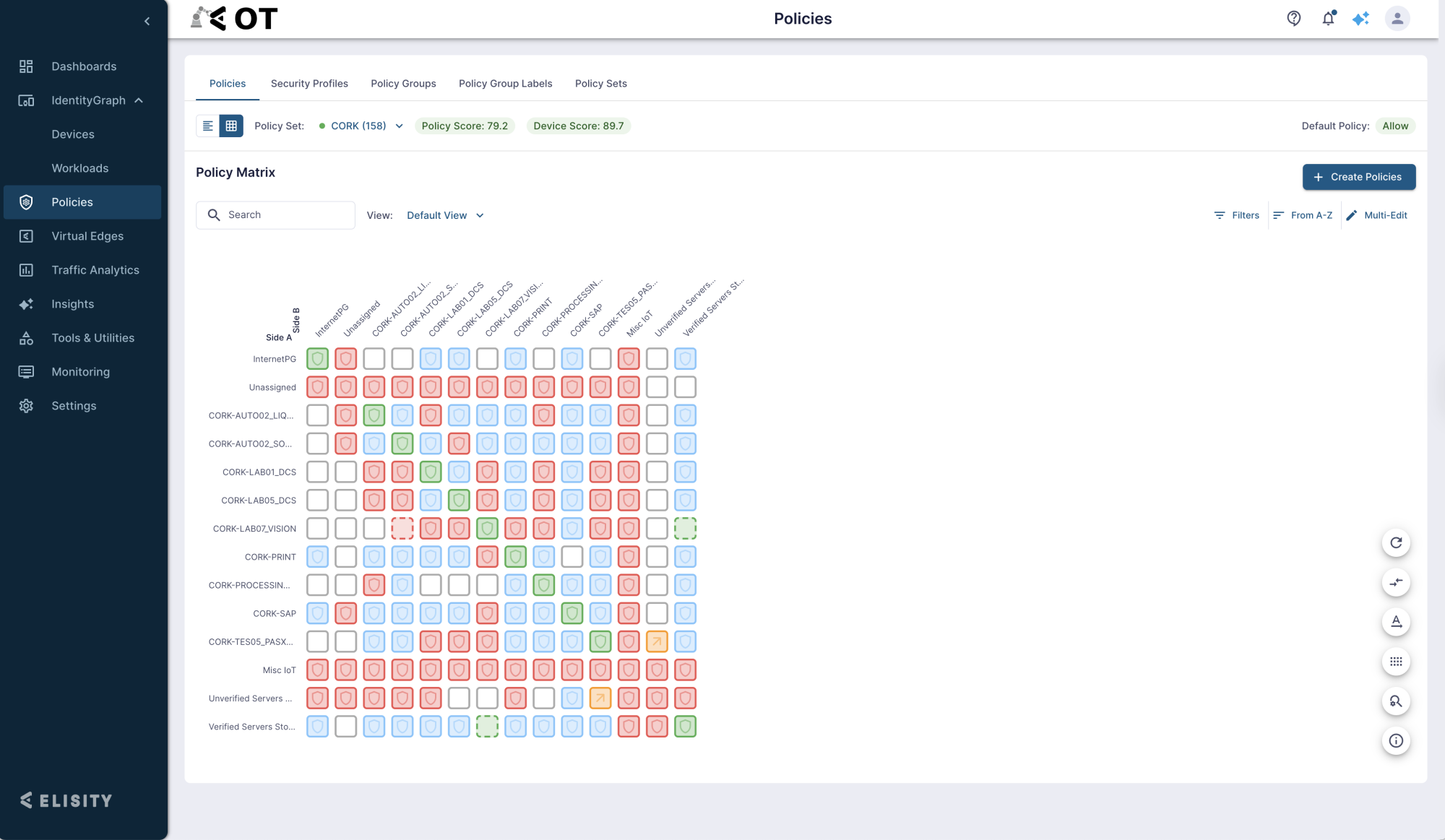
The Elisity Microsegmentation Platform applies Zones and Conduits as a software construct on the network infrastructure already running the plant. Operators define zones by IEC 62443 security level, plant area, production function, or any other attribute. Communications between zones flow through Elisity-enforced conduits with the policy each zone pair requires.
The deployment model is where most OT segmentation programs have failed. Production lines have rare and narrow change windows. Replacing equipment, re-assigning IP addresses on legacy devices, or installing agents on PLCs is unacceptable to plant managers. Most legacy approaches require all three. Industry research shows roughly 60% of legacy microsegmentation programs stall before reaching production.
The Elisity Microsegmentation Platform deploys on the network infrastructure plants already operate, including ruggedized industrial switches from Cisco, Juniper, Arista, HPE Aruba, and Hirschmann.
For decades, securing operational technology has felt unsolvable. Plant managers cannot accept downtime. Production equipment cannot run security software. Industrial networks were never designed for segmentation, and the people who run them are measured on uptime and yield, not policy enforcement. Every previous attempt to extend modern security into OT - overlay networks, agent-based platforms, rip-and-replace firewall architectures - has either failed outright or settled for protecting the IT side of the plant while leaving the production floor exposed.
The Elisity Microsegmentation Platform was built specifically for this problem. Five things make it distinct in the industrial cybersecurity market.
Every manufacturing site, refinery, water utility, and pharmaceutical facility already has a network. Elisity turns that existing network - including ruggedized industrial switches from Cisco, Juniper, Arista, HPE Aruba, and Hirschmann - into the place where security policy is enforced. No new appliances sit in the production traffic path. No software is installed on PLCs, HMIs, or robots. No re-cabling of the plant floor is required.
The result: an OT security control that has historically required capital projects and multi-year construction programs becomes one that delivers in weeks on infrastructure already on the plant balance sheet.
Industrial cybersecurity tools were built for one slice of the problem. OT monitoring platforms see industrial protocols but cannot enforce policy. IT firewalls protect zone boundaries but cannot reach the device level. Endpoint security agents do not run on PLCs, HMIs, or robotics at all. The result has been three or four parallel security programs that do not share a policy model.
Elisity unifies all of it. The corporate ERP system, the engineering workstation, the historian server, the robot on the line, the building HVAC controller, and the contractor laptop on the guest network all live under the same rules. This matters more every year as IT and OT environments converge under unified leadership and as plants connect to cloud services, remote vendor support, and corporate networks.
The result: organizations consolidate from three or four separate segmentation efforts to one platform, with consistent policy enforced everywhere instead of best-effort across silos.
The international standard for industrial cybersecurity, IEC 62443, calls for segmenting industrial environments into Zones (groups of assets with common security requirements) and Conduits (the controlled communication paths between zones). The framework is well understood by industrial security teams. Most manufacturers have not implemented it fully because the historical approach required new firewalls between every zone, IP address changes, VLAN redesigns, and multi-year construction projects on networks that cannot afford downtime.
Elisity applies Zones and Conduits as a software construct directly on the network equipment already running the plant. Operators define a zone by IEC 62443 security level, plant area, or production function. Communications between zones flow through Elisity-enforced conduits with the policy each pairing requires. New plants, acquisitions, and equipment changes inherit the model automatically.
The result: a standard most industrial operators have aspired to for a decade becomes operationally achievable in weeks, on existing equipment, with the team already on staff.
Traditional industrial segmentation tools key on IP addresses, VLAN tags, and physical network locations. The moment a robot moves to a different cell, a PLC is replaced, a plant is acquired, or a contractor laptop joins the network, the policy breaks and someone has to rebuild it. In OT environments, where equipment operates for decades but moves under M&A and modernization, that brittleness has historically meant constant rework or rules so permissive they protect nothing.
Elisity bases policy on who or what a device is - its identity, role, production function, owner, and risk score - not where it sits on the network. When a device moves, the policy moves with it. When a new plant is acquired, its assets inherit the corporate policy automatically based on their identity attributes.
The result: policies stay correct without constant rework, and the platform contains a threat in real time instead of being one step behind a changing plant.
The single biggest reason OT segmentation programs have stalled across the industry is the fear that a wrong rule will stop the line. Plant managers will not approve a security project that risks production yield, and they have decades of experience telling them that "trust me, it will work" usually does not. Elisity removes the fear by showing operators exactly which device-to-device communications a new policy will block before any traffic is actually stopped. The plant team reviews the impact, adjusts, and only then activates. If anything is wrong after enforcement, one click rolls it back.
The result: the security team and the plant team see the same evidence before any policy is active. Approvals that used to take quarters take days.
Nominations for the 2027 Cybersecurity Stars Awards open later this year. Leave your email and we’ll send you one heads-up the day they go live.
We’ll email you the moment 2027 nominations open.