2026 WINNER · CYBERSECURITY STARS AWARDS
Intezer · Autonomous Security Operations Platform
Best Security Operations Center (SOC) Platform



Intezer AI SOC delivers 24/7, forensic-grade triage across 100% of alerts, with less than 2% escalated for human review, dramatically accelerating incident response and containment. Powered by ForensicAI™, Intezer specializes in deep forensic investigation to deliver unmatched accuracy and speed, significantly reducing cyber risk and enabling security teams to operate effectively without reliance on outsourced services.
Used by global enterprises including MGM Resorts, NVIDIA, Salesforce, and Equifax, Intezer represents a shift in cybersecurity operations: from selective, human-capacity-limited alert handling to AI-driven investigation across every alert, helping organizations reduce cyber risk at scale.
Intezer's AI SOC platform automatically investigates every security alert, enabling organizations to detect, triage, and respond to threats at enterprise scale. It combines battle-tested forensic capabilities with agentic AI to deliver autonomous triage and investigation across endpoint, cloud, identity, network, and phishing telemetry. Powered by ForensicAI™, the platform applies deep analysis of behavior, code lineage, execution context, and forensic evidence to determine whether activity is malicious or benign.
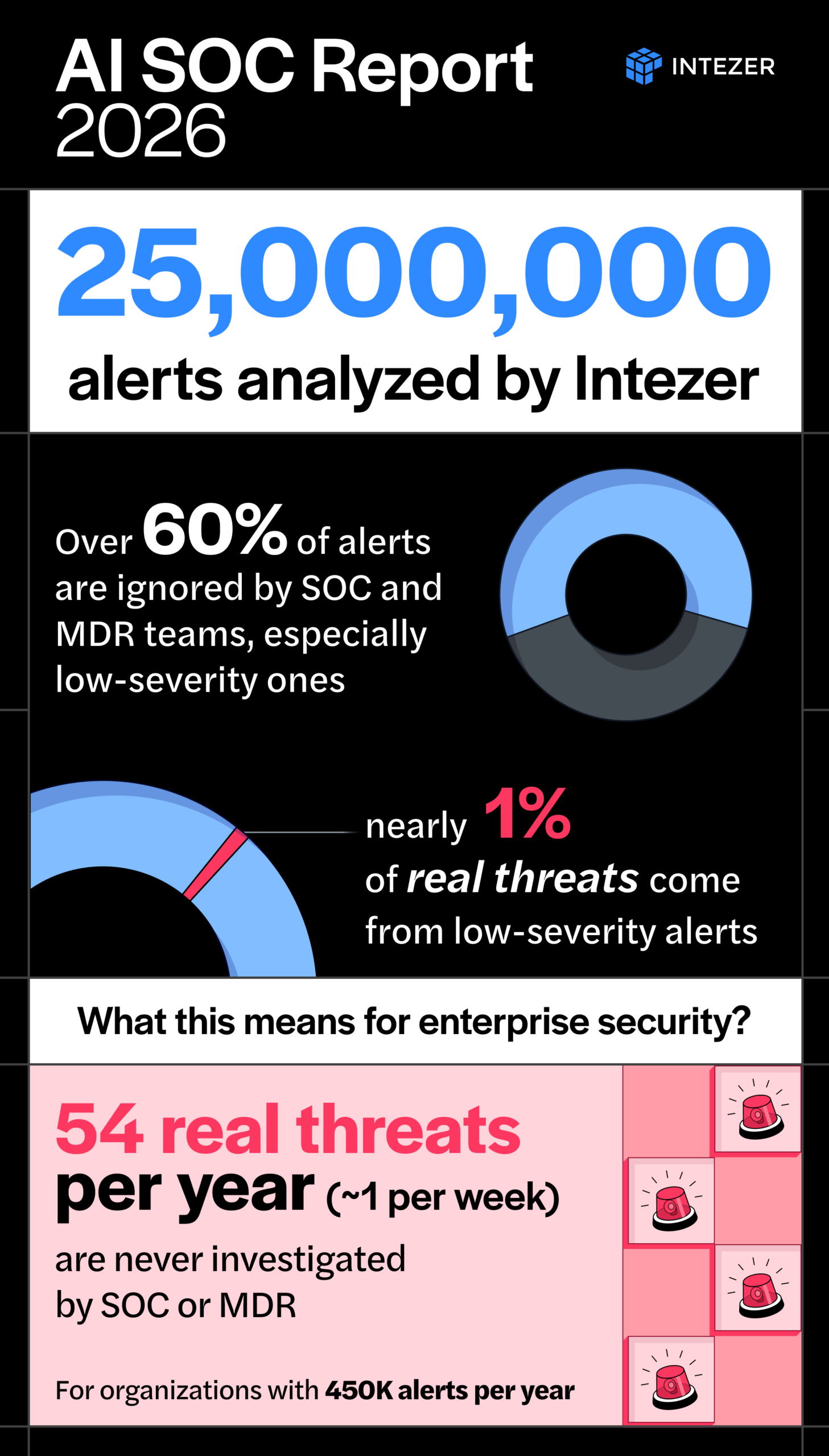
This enables Intezer to move beyond surface-level detection and deliver high-confidence, evidence-based verdicts at enterprise scale. In 2025, Intezer analyzed more than 25 million security alerts across enterprise environments, demonstrating its ability to apply AI consistently across large, complex security datasets.
The platform also helps SOC teams shift from manual ticket processing to outcome supervision by prioritizing analyst attention on incidents that require validation, judgment, and response.
Most AI SOC platforms are built on LLMs at their core, summarizing and enriching alerts, but still requiring analysts to validate and close the loop. Because LLM inference carries significant per-query compute costs, these vendors pass that cost structure on to customers through per-alert pricing. The result is that customers must cherry-pick which alerts to submit, almost always filtering down to high-severity ones and leaving low and medium alerts uninvestigated, precisely where early-stage threats hide. Intezer takes a fundamentally different approach with AI orchestrating deterministic, forensic-first analysis built on proprietary capability such as binary code comparison, and memory forensics.This approach is highly scalable and enables per-endpoint pricing rather than per-alert pricing, so customers can investigate 100% of alerts across every severity level without cost escalation. Full coverage becomes the default, not a premium add-on.
When comparing Intezer to MDRs, the difference is structural, not just technological. MDR scales investigation through human labor, which means investigation depth, consistency, and coverage are all bounded by analyst headcount and shift availability. In practice, approximately 60% of alerts go unreviewed andMDRs deprioritize low and medium severity by necessity, and that backlog is where real risk accumulates. Intezer replaces the human-constrained operating model entirely. AI performs forensic-level investigation on every alert, 24/7, while humans supervise outcomes and engage only on escalated incidents. Less than 2% of alerts reach a human, and when they do, customers get direct access to Intezer security experts, not a ticketing queue.
Beyond triage and investigation, Intezer also closes the loop on detection quality in a way neither LLM-based tools nor MDRs do. In most security operations models, detection engineering is a periodic exercise where rules are tuned reactively when noise complaints pile up, and coverage gaps are discovered through audits rather than continuous feedback. Intezer feeds every investigation outcome back into detection logic automatically, surfacing noisy rules, broken telemetry, and missing coverage in real time. Customers get continuously improving MITRE ATT&CK coverage mapped to their environment, with detection rules that live in their own SIEM, not locked inside a vendor's black box.
Nominations for the 2027 Cybersecurity Stars Awards open later this year. Leave your email and we’ll send you one heads-up the day they go live.
We’ll email you the moment 2027 nominations open.