2026 WINNER · CYBERSECURITY STARS AWARDS
Island Enterprise Network
Best Secure Access Service Edge (SASE)


Island is the enterprise work platform, the ideal environment for modern work where people, AI, and agents operate side by side. Island enables organizations to eliminate the trade-off between security and productivity, giving IT and security teams full control while actually accelerating AI-powered productivity. Millions of users rely on Island to safely adopt AI, dramatically reduce costs, and simplify infrastructure. Island is backed by world-class investors such as Coatue Management, Insight Partners, Sequoia Capital, Cyberstarts, and more.
Island is rebuilding SASE for the age of modern work.
Traditional SASE was designed around a network-centric world where security teams routed traffic through gateways, inspected packets, and enforced policy somewhere between users and applications. That model worked when applications lived in data centers.
Modern work is different.
Work happens inside browsers, SaaS applications, AI tools, and increasingly autonomous AI agents. Island CTO and co-founder Dan Amiga predicts that AI agents will soon outnumber human workers by as much as 100 to 1. In that world, securing networks is no longer enough. Organizations must secure the interactions between users, agents, applications, and data.
Island's modern SASE architecture moves security to where work actually happens.
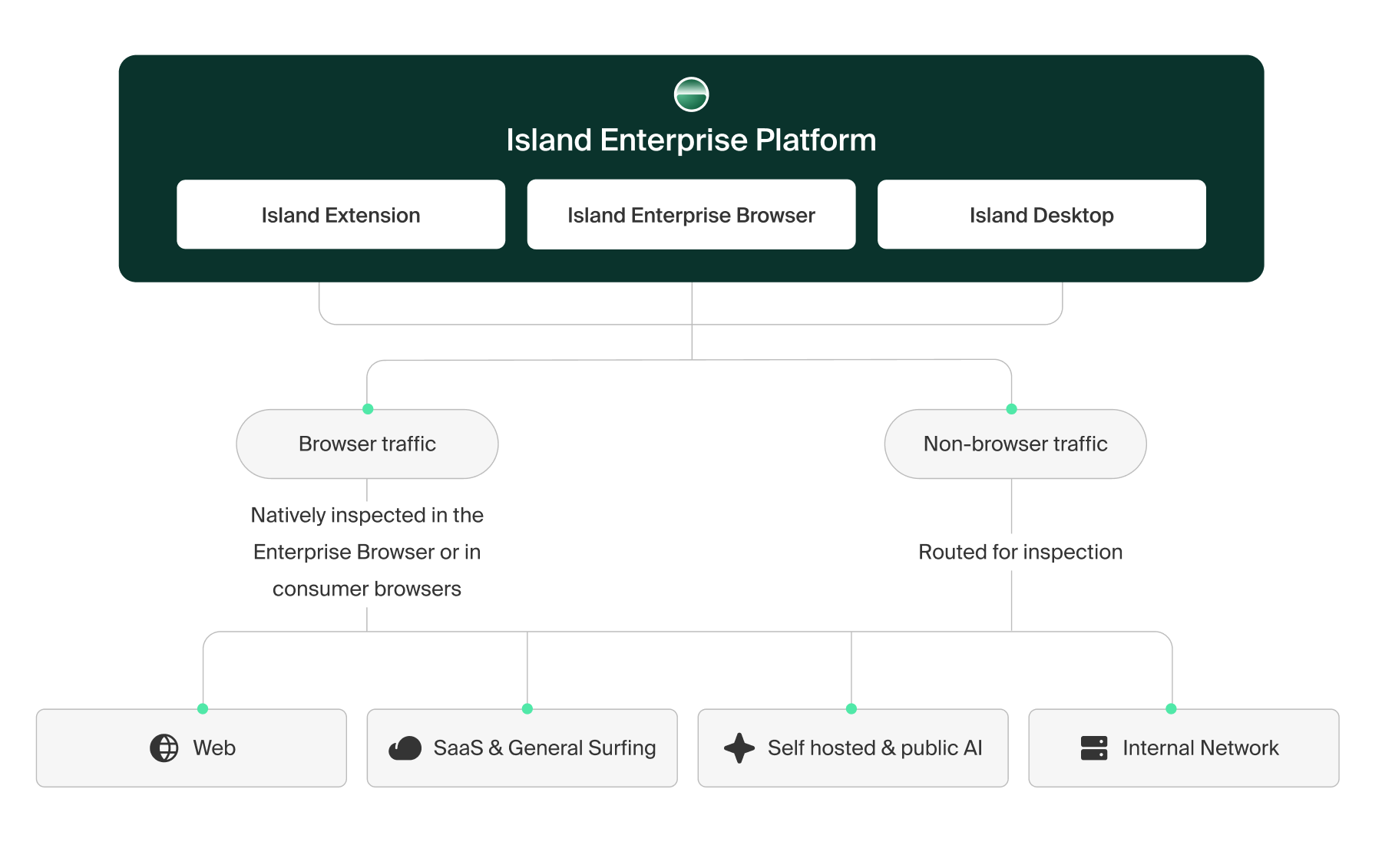
Island delivers a complete modern SASE platform that includes:
Traditional SASE platforms rely on traffic steering and centralized inspection. Island's architecture, built on three hyperscalers and two network stacks, is designed to keep users on the most direct and secure path possible.
The architectural advantages are measurable. Up to 90% of sessions take a direct path with no backhaul. Organizations can deploy Island in as little as five minutes across managed and unmanaged devices. Direct-path connectivity can accelerate application access by up to 10x compared to traditional traffic-steering approaches. And because browser security is enforced at the point where work occurs, Island eliminates the need to break and inspect SSL/TLS traffic for browser sessions.
Key capabilities include:
What makes Island stand out is that it secures the presentation layer rather than relying solely on the network layer.
Network-based SASE products see traffic. Island sees work.
Instead of making decisions based on IP addresses, routes, and packets, Island understands applications, users, AI tools, data, and context. It can determine what data is being shared, where it is going, and whether the action should be allowed.
The result is a radically simpler SASE architecture that eliminates unnecessary infrastructure, removes user friction, accelerates AI adoption, and delivers security exactly where modern work occurs.
Island is not another network security platform. It is a modern SASE architecture built for a world where applications, browsers, and AI agents have become the new enterprise perimeter.
Legacy SASE vendors are still refining an architecture designed for a different era of computing. Island started by asking a more fundamental question: what if the architecture itself is wrong?
The first generation of SASE emerged to solve a network problem. Corporate applications were moving to the cloud, users were working remotely, and organizations needed a way to extend perimeter security beyond the office. Vendors responded by building larger distributed networks of gateways, inspection points, and cloud-delivered security services.
Every inspection point adds latency, complexity, and operational overhead. The result is a "detour tax" where users, applications, and data are forced onto longer paths simply so security infrastructure can observe them.
That tradeoff has become increasingly difficult to justify. AI didn't create the problem, but it exposed its limitations at scale.
Modern work is no longer linear. Employees move between SaaS applications, AI assistants, private applications, browser extensions, APIs, and cloud services in a continuous flow. Sensitive information moves between systems in ways that traditional network controls were never designed to understand.
Agentic AI compounds the challenge even further.
Tool calling, Model Context Protocol (MCP) access, agent-to-agent communication, and remote agent execution do not resemble traditional human web traffic. A network proxy can observe that a session exists, but it cannot understand what is happening inside that session, what information is being exchanged, what tools are being invoked, or whether organizational policies are being violated.
Island addresses this challenge with a fundamentally different architecture.
Its approach is built around what Island calls the Perfect Packet. For every session, the platform selects the most efficient and secure path based on policy, identity, device posture, application context, and risk. In most cases, enforcement occurs locally on the endpoint, eliminating the need to steer traffic through a cloud gateway. Users connect directly to destinations while security remains fully enforced.
This architecture delivers what traditional SASE promised but rarely achieved: superior security, a better user experience, and operations that scale without compounding complexity.
Island combines four capabilities that traditional network-centric architectures struggle to deliver:
The result is visibility and control at the point where decisions are made and data is exchanged, rather than after traffic has already traversed the network.
While most vendors continue expanding network infrastructure, Island is building for a world where applications, AI, and autonomous agents increasingly define how work gets done. The future of secure access will not be determined by who owns the most gateways. It will be determined by who can understand and govern work itself. That difference is not incremental. It is architectural.
Nominations for the 2027 Cybersecurity Stars Awards open later this year. Leave your email and we’ll send you one heads-up the day they go live.
We’ll email you the moment 2027 nominations open.