2026 WINNER · CYBERSECURITY STARS AWARDS
Cybersecurity Upside Down · Benny Czarny
Best Cybersecurity Book



OPSWAT focuses on preventing malware and zero-day attacks by operating under a simple assumption: every file and every device should be treated as a potential threat. OPSWAT products are designed to enforce secure data transfer and controlled device access while reducing operational risk. As a result, 98% of U.S. nuclear power facilities rely on OPSWAT for cybersecurity and compliance.
This approach is delivered through a comprehensive platform built on patented technologies used worldwide to secure critical environments. These technologies provide advanced prevention against known and unknown threats.
Enterprises continue to increase cybersecurity spending each year, yet breaches continue to rise. There are thousands of threat prevention solutions on the market, but most of them share one crucial flaw: they are based on detection, which is never 100% perfect.
To address this limitation, OPSWAT developed MetaDefender, an advanced threat prevention platform designed to go beyond detection. MetaDefender integrates more than 20 products that secure multiple segments of critical infrastructure environments, including endpoint and file security, secure patch management, unidirectional security gateways, cross-domain solutions, secure data transfer, and advanced threat prevention. At the core of the platform is OPSWAT's Deep CDR Technology (Content Disarm and Reconstruction), which removes threats from files by rebuilding them and stripping potentially malicious elements such as embedded scripts or active content. The platform also combines adaptive sandboxing, AI-driven analysis, and deterministic data flow controls within a unified architecture designed for operational technology and regulated environments.
Guided by the principle "Trust no file. Trust no device." OPSWAT prevents threats, including AI-generated, zero-day, and supply-chain attacks, before they can disrupt operations. The company also supports cybersecurity workforce development through OPSWAT Academy, which provides global education and certification programs focused on IT and OT security.
OPSWAT founder Benny Czarny expands on this prevention-first philosophy in his book Cybersecurity Upside Down, which argues that detection alone cannot stop modern attacks and that security strategies must prioritize prevention.
After more than 20 years of successfully implementing Deep CDR Technology in over 1,000 organizations, OPSWAT founder and author Benny Czarny wrote this book because CDR remains underrecognized as a critical solution for data protection. The goal is to provide readers with a clear understanding of how CDR works, why it offers unique protection for productivity files, and how it compares to other cybersecurity solutions.
The book is titled Cybersecurity Upside Down to reflect the idea that securing systems effectively requires flipping long-held assumptions and starting from a different point of view. Many of today's security strategies are built backwards, focused on detection after exposure, rather than prevention before execution. The book does not suggest replacing existing tools, but rather rethinking where prevention fits in the security model and why relying solely on detection leaves blind spots that attackers exploit.
Its examples draw from high-risk environments such as critical infrastructure, government, and regulated industries, but its core principles apply to any organization that handles files, data, or digital workflows.
Readers will gain a clearer understanding of why modern attacks succeed, a prevention-first mental model, and a stronger foundation to evaluate cybersecurity strategies and claims. Most importantly, though, anyone who reads Cybersecurity Upside Down will think differently about what it means to really be secure.
Cybersecurity Upside Down is part technical guide, part personal journey, and part call to action. Czarny shares the frustrations, failures, and insights that led to the development of prevention-first security — grounded not in theory, but in real-world constraints and adversarial reality. This book doesn't ask you to add more tools; instead, it asks you to think differently about them.
The book is approachable and accessible for audiences ranging from cybersecurity professionals to CISOs, government and critical-infrastructure leaders, students or technologists looking beyond buzzwords, and anyone who wants to understand why today's security stack feels increasingly fragile.
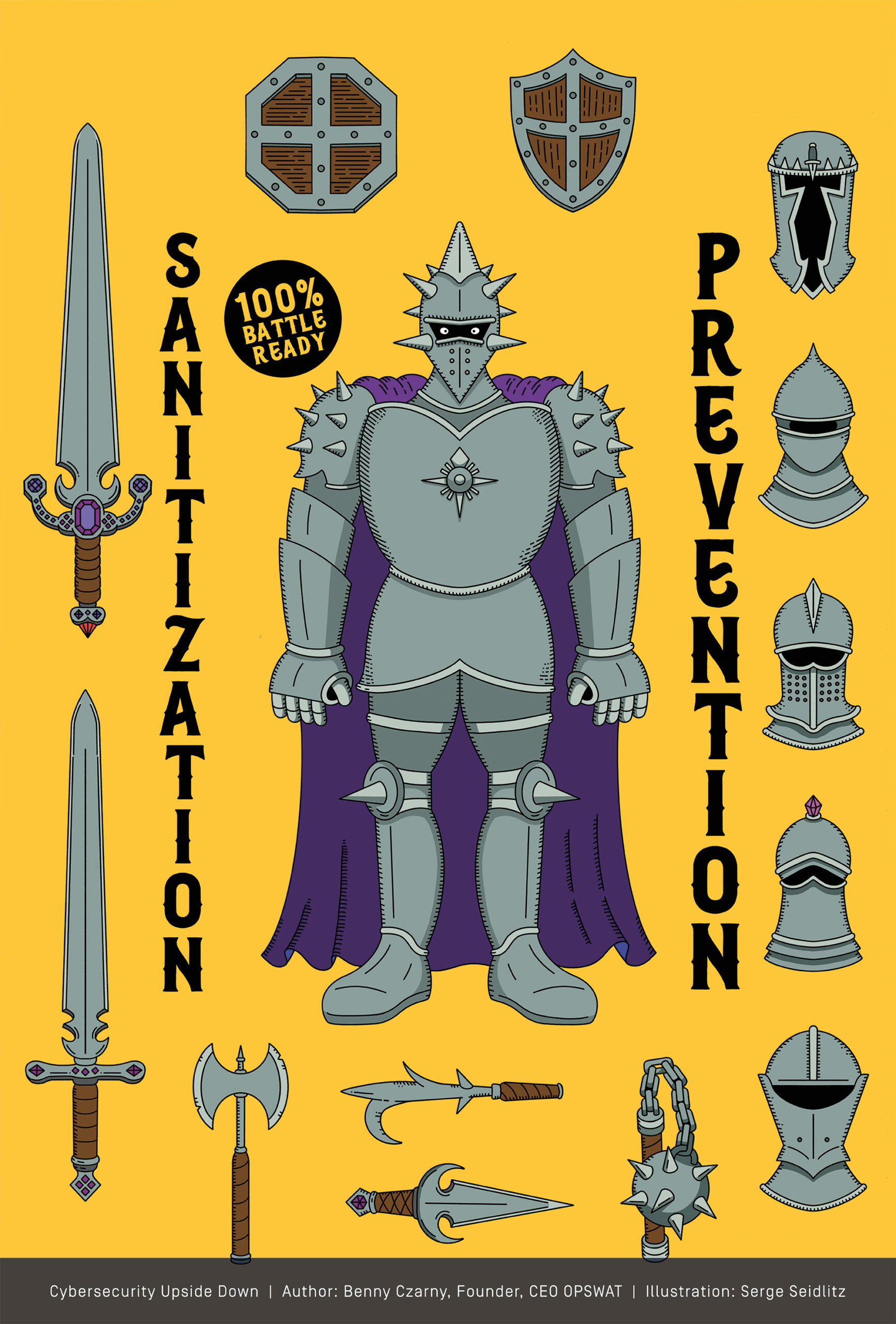
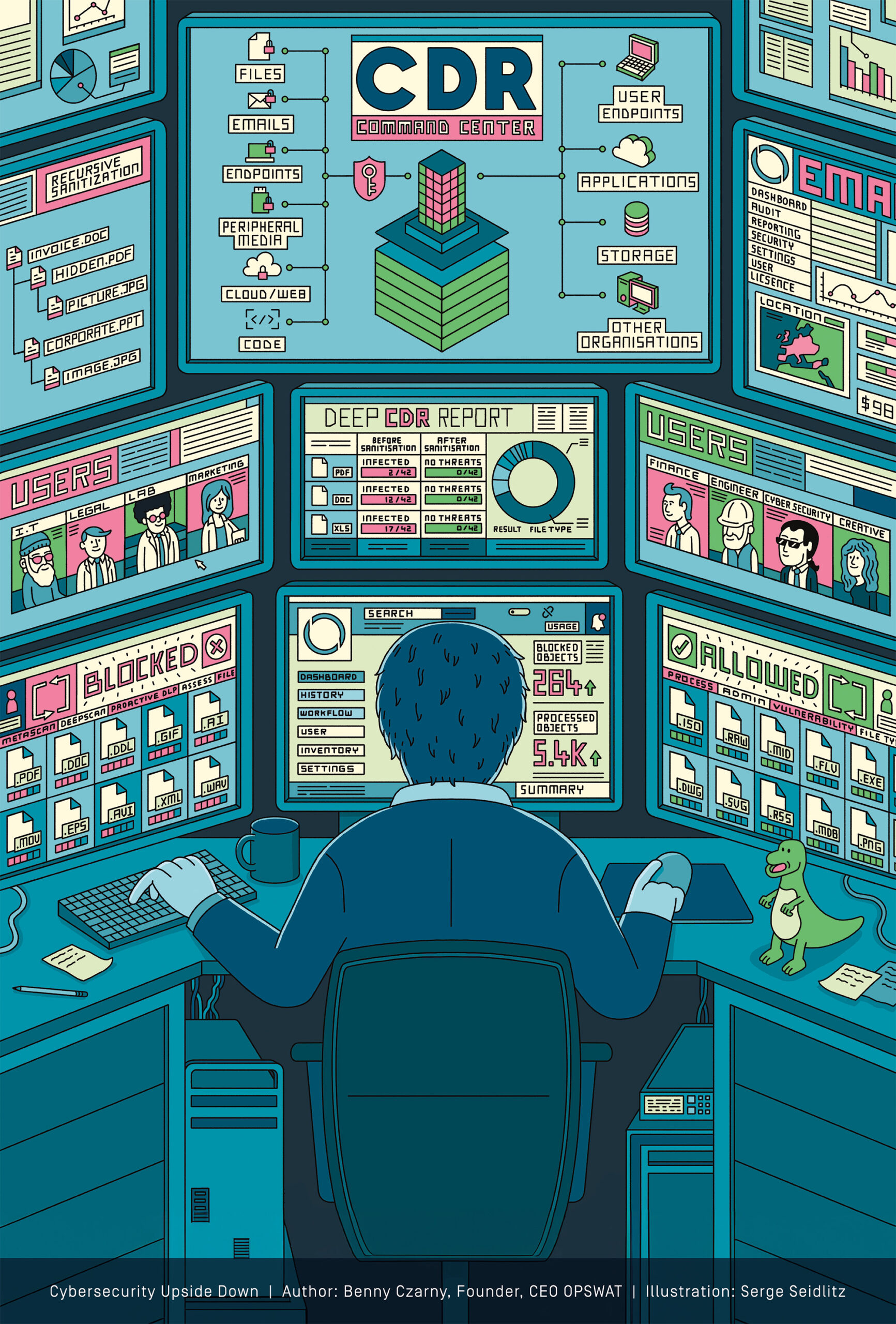
To enhance the narrative of the book, London-based illustrator Serge Seidlitz translated abstract cybersecurity concepts into creative visual metaphors. These striking graphics reinforce the central theme of seeing familiar problems in entirely new ways.
The journey of this book from concept to publication has been shaped by valuable discussions with the OPSWAT team — comprising over 1,000 professionals across 25 countries — to distil complex cybersecurity concepts, provide accessible knowledge, and support digital literacy for all. Cybersecurity Upside Down explains why detection alone will always be reactive and why prevention must come first. It explains technical concepts, but it is not written like a textbook or product manual. It is practical, opinionated, and intentionally visual. It's a fundamental shift in how we think about risk and resilience.



Nominations for the 2027 Cybersecurity Stars Awards open later this year. Leave your email and we’ll send you one heads-up the day they go live.
We’ll email you the moment 2027 nominations open.