2026 WINNER · CYBERSECURITY STARS AWARDS
Token Security · AI Agent & NHI Security Platform
Most Innovative Agentic AI Security Platform


AI agents are no longer just tools. They are autonomous identities that write code, access sensitive data, and execute workflows across systems at machine speed. They inherit access from humans, operate with elevated privileges and act in ways that change based on their objective, meaning identical permissions can produce different outcomes.
This breaks traditional identity and access management (IAM) systems and security models, which were designed to manage access, not behavior. IAM can verify credentials, but they cannot determine whether an AI agent should be performing a specific action or chaining actions across systems. As a result, organizations lose control over what these agents do after access is granted.
Token Security solves this by making identity the control plane for AI agents. The platform continuously discovers every agent and non-human identity, understands their intent and access, and enforces policies to ensure security and compliance. Instead of relying on static permissions and user access reviews, Token evaluates each agent and its access based upon its defined intent to properly enforce least privilege controls.
This applies even when the agent is operating with valid credentials and within existing permission boundaries. For example, an agent designed to generate reports from a specific data set that attempts to query sensitive resources outside its scope would be blocked.
This allows organizations to adopt AI at scale while maintaining control over how autonomous systems operate across cloud, SaaS, and internal environments.
Token Security delivers a unified system for controlling AI agents as active identities, not static accounts.
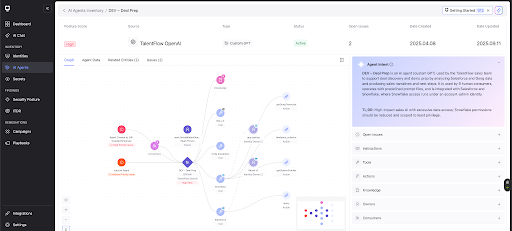
The platform begins with continuous discovery, identifying all AI agents across the environment, including custom GPTs, MCP servers, and workflow automations. It maps ownership, permissions, and system access to establish a contextual view of how identities operate, interact, and execute across systems and workflows.
From there, Token defines intent. Each agent is assigned a clear purpose, establishing the boundary for what it is allowed to do and forming the basis for least privilege enforcement.
Token continuously evaluates each agent's access to ensure it aligns with the agent's defined purpose and scope. If access deviates from its scoped intent, agent access can be blocked before it can execute across systems and workflows, even when the request is permitted by existing access controls.
The platform continuously enforces least privilege by right-sizing permissions based on actual access, behavior, and defined intent. It also maintains traceability by logging agent actions across systems and multi-agent workflows for investigation and compliance.
Finally, Token enforces lifecycle governance by assigning ownership, rotating credentials, and retiring orphaned agents that persist beyond their intended use, eliminating persistent, unmanaged access and reducing long-term exposure.
Token Security stands apart because it does not treat AI agent security as a visibility problem. It treats it as a governance and control problem.
Most solutions focus on discovery, posture, or risk analysis. They identify AI agents and highlight potential issues, but they do not prevent those agents from executing unsafe actions. Token closes this gap by enforcing identity and access controls at the point of execution.
One of Token Security's core innovations is intent-based security. Traditional systems manage permissions, which define what an identity can access. Permissions define access. They do not define behavior. Token controls agent identity and access behavior by defining what an agent is supposed to do and continuously evaluating its access against that expectation and blocking access that falls outside it.
Token is designed specifically for autonomous systems. Legacy IAM, CIEM, and secrets management tools cannot model non-deterministic behavior or control how agents chain actions across systems and workflows. It addresses a new class of identity where access is dynamic and context-dependent.
Enforcement occurs across both identity and workload layers. Token controls what an agent can request and ensures access to downstream systems that falls within defined boundaries, even when the request is permitted by existing access controls. This prevents out-of-scope access even when an agent attempts to perform unauthorized actions with valid credentials.
The result is immediate containment of AI-driven risk, preventing lateral movement, data exposure, or unintended execution across connected systems and workflows.
Token Security provides organizations a unified control plane to enforce identity-based security across AI agents, service accounts, API tokens, and machine identities.
Nominations for the 2027 Cybersecurity Stars Awards open later this year. Leave your email and we’ll send you one heads-up the day they go live.
We’ll email you the moment 2027 nominations open.